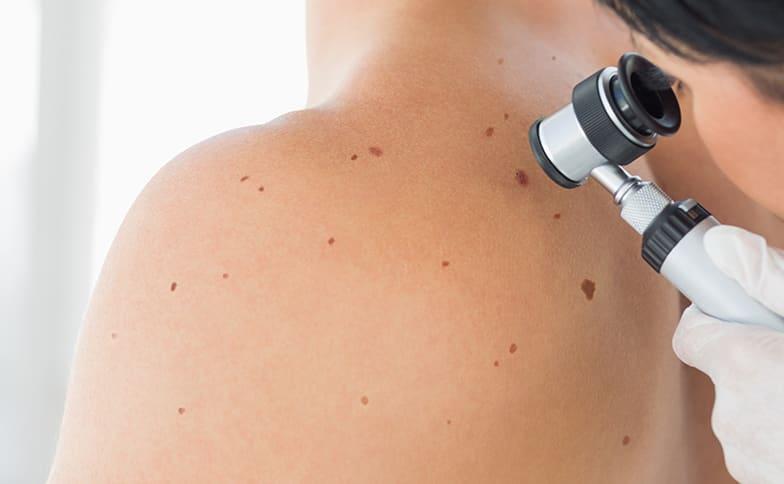
A skin check might be something you’ve heard of before but weren’t sure what it is. It’s a simple screening measure that might save your life. Yes, you strip down to your birthday suit, sometimes with a dermatologist you just met, and let them look you over from head to toe, including the nooks and crannies you can’t see or forgot even existed. Sounds exciting right? Your derm might even use a fancy light device called a dermatoscope to evaluate skin lesions and make you feel even more like a piece of meat being inspected by the USDA. If you didn’t leave your skin check appointment feeling a little embarrassed or vulnerable, it probably wasn’t done right.
You see, a skin check is a valuable tool to screen for skin cancer. If caught early, melanoma, the deadliest form of skin cancer, has a survival rate at 99%. Performing a skin exam and detecting skin cancer is a skill honed by dermatologists during their training. Dermatologists train to recognize common benign growths, rashes and skin cancer. Skin cancer can arise anywhere you have skin, and not all skin cancers are caused by UV light. So yes, skin cancer can occur even where the sun has never shined and can even pop up in the nails, on the eyelids, scalp, lip or on the palms and soles. If you’ve ever used a tanning bed before, odds are you tanned nude. As a result, traditional areas, like the buttocks, that might not see sun often, are now at an increased risk. Believe it or not, but I’ve diagnosed quite a few booty basals (basal cell carcinomas–the most common type of skin cancer) in my career.
You might also be wondering, what about the genital area? We do find skin cancers there as well and recommend including a check of those areas and around the anal area as well. To top it off, I also look at the tongue as a part of a complete skin exam. What you might not appreciate is that the inside of your mouth, like the inside of the vaginal area, is skin too. It’s mucosal or wet skin. Each year I catch both precancerous lesions and squamous cell carcinoma (SCC) of the tongue. Many of my patients have risk factors for tongue cancer, like alcohol or tobacco use, and don’t see a dentist. Side note—dentists will perform a thorough oral cancer screen when you go in for your checkup. As if I haven’t scared you enough, I have also diagnosed skin cancer inside the nose. It’s also considered mucosal skin and you should pay attention if you notice a lesion there too.
Now that I’ve ramped up your anxiety and convinced you that you need to get checked, how should you prepare for a skin exam? Be prepared to trade your clothes, including undergarments, for a gown. If you prefer your dermatologist not to look somewhere or want to leave on any clothing, let them know. For my patients, I warn them that I will be touching areas of their face, ears, and arms because precancerous likes, known as actinic keratoses, are often felt more than seen. Take your nail polish off before your appointment and skip your make up routine. Don’t style your hair because I will likely mess it up as I comb through it to evaluate your scalp. I also tell my patients don’t stress over shaving or thinking your toes are in desperate need of a pedicure. Even if you haven’t shaved in weeks (guilty as charged) or your toenails look scary, it isn’t necessary to go overboard. One of my patients told me she showered, shaved and wore a matching bra and underwear to her skin check appointment and then proceeded to tell me she doesn’t even do that for her husband anymore. Although flattered, I told her not to go the extra mile next time for me and maybe do it for her hubby instead. Ironically, he’s now a patient of mine too.
A skin check can seem like a terrifying process, but it is a relatively noninvasive, efficient way to screen for skin cancer. If a concerning lesion is found, your dermatologist will talk about next steps, which often includes a biopsy and an evaluation of the lesion under the microscope. Don’t let the fear of what might be found scare you off. There’s power behind prevention and early detection and the skin exam exemplifies just that.
Trotter’s Take:A skin check is a simple screening measure that can detect skin cancer early and can potentially save lives.
Want to strip down and learn more? Jump on my latest podcast with Dr. David Oberlin as we walk you through a skin exam and convince you to get naked and get checked.